Membrane keyboards are still justified
Technical article also in Elektronik Industrie 08/2020: Article as .pdf >>
In the food, laboratory, and medical sectors, membrane keypads continue to play an important role today due to their closed surface, chemical resistance, and impermeability to liquids and dust. N&H Technology, based in Willich, Germany, has been manufacturing membrane keypads for all industries for over 20 years.
Preferred choice not only in the medical field
Membrane keypads are the preferred choice, especially for devices with a limited number of functions that require good visibility and constant user interaction. In the medical field, examples include nurse call systems, hospital bed controls, input keypads for diagnostic devices and defibrillators, and other patient care interfaces. Many of these input devices are also operated by inexperienced users, such as elderly patients, making a complex touchscreen solution less than ideal.
Design options for membrane keypads
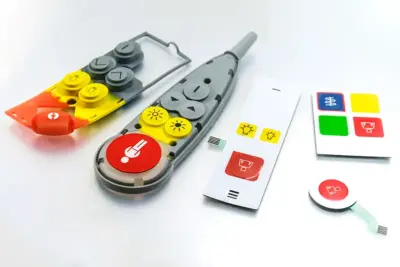
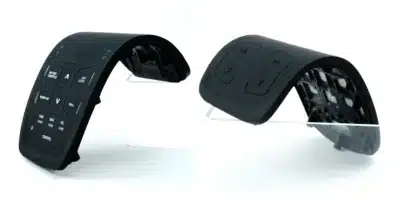
Membrane keyboards offer a user-friendly and intuitive interface thanks to their diverse design possibilities . With the use of appropriate tools, the membrane keypad can be shaped into virtually any form. In addition to the standard screen printing process, digital printing is particularly suitable for creating color gradients and for prototypes and small production runs. Specially embossed films can even achieve metallic effects , such as brushed stainless steel or anodized aluminum. Another advantage over display solutions is that the printed surface, as well as any optional integrated LED status indicators, can be viewed from a 180° angle.
Membrane keyboards impress with their flat design

The flat construction of a membrane keypad consists of a laminated sheet made up of at least four layers: the decorative layer, the upper and lower switching layers, and a spacer layer. The decorative layer is the top layer of the keyboard and is made of polyester or polycarbonate. It is printed on the back to ensure maximum protection against abrasion.
In comparison with other flexible materials, polyester stands out with a high life cycle of over one million switching cycles , very high abrasion resistance and very good resistance to chemicals.
For applications in the medical field and areas with high hygiene requirements, the front film can be coated with an antibacterial coating. This antimicrobial polyester kills or inhibits bacterial growth and provides constant protection against bacterial contamination.
Functional elements of a membrane keypad
The functional elements of the membrane keypad are the lower circuit membrane with the printed conductors, LEDs, switching points and the connection lug located on it, as well as the upper circuit membrane with the contact surfaces. The spacer foil acts as an insulator, separating the upper and lower switching foils or, in the case of a version with metal snap-action discs, acts as a fixing foil.
Illuminated membrane keypads

Backlighting options vary depending on the application requirements. Illuminated keypads are particularly necessary in the often darkened working environments of the medical field, allowing key functions to be easily located. LEDs can be easily integrated into the existing keypad or, if necessary, incorporated into an additional LED keypad.
Special adhesives and sealing materials are used to ensure the LEDs function even in harsh environments with, for example, high levels of vibration. Membrane keyboards can be backlit using LGF (Light Guide Film) . This maintains the typical flat design and flexibility. LGF technology uses LEDs positioned along the edge of a very thin (0,1 to 0,2 mm), highly refractive film . Due to this high refractive index, only a very small number of LEDs are needed for homogeneous illumination , depending on the size of the membrane keypad .
Each key can be backlit in different colors. Unlike EL backlighting, LGF technology does not require a high-frequency AC power source. A special feature is the disappearing keycaps. These are keycaps that are invisible when the keyboard is off and only become visible when backlit. This allows for a clear on/off signal.
Tactile feedback
Another advantage of membrane keypads is the tactile feedback they provide to the user. Snap domes offer a perceptible tactile sensation when pressed , and depending on the design, an audible click. This direct feedback can reduce data entry errors. Metal snap domes are available in various sizes, shapes, and actuation forces, and are preferred for applications with a high number of keystrokes.
More technical articles on keyboards
Functional key design for membrane keypads as a key to process stability. Technical article from PC & Industry 04/2026…
Efficient device operation in medical technology. In medical technology, the selection of individual components is crucial…
Traditional design combined with touch technology: A modern operating solution for HMI and industrial applications. Technical article published in…
A decision-making aid for keyboard developers: Comparison of haptics, design and application areas. Published in…
Efficient input in a small format: The versatility of membrane keypads and silicone keypads. Smart home applications and their…
Industrial keyboards: Robust, reliable and easy to use. Published in PC & Industry 09/2021. Article…